Monday, March 26, 2012
TOS Review: Action Alert
Have you heard of Action Alert? If you have kids that are allowed to use the internet, you may be interested. Action Alert is a downloadable software that helps you protect your children while they're online, as well as assisting you in providing guidance and accountability.
There are two versions available - free, and the "maximum protection" version for $29.99. From what I can tell, the main difference between the two is that with the paid version, you can watch a video of everything your kid has been doing online. The free version still records all of this information, but you need to use the paid version to see it.
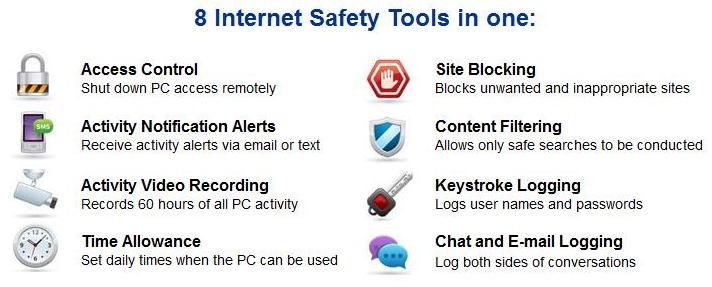
I like the idea of Action Alert. I like that you can limit access to certain times of the day, and limit how long a person can be online. I like that it records everything your kids are doing, including chats that may not otherwise be available to you after the fact. I did find that the notifications were not immediate, however. There was actually a delay of several hours in the notifications I received. That leaves plenty of time for a kid to get themselves into trouble, if you ask me.
I only tried out the paid version, so I don't know if this applies to the free version, but in the paid version you can select which areas to apply to which users. If you want to turn off all monitoring for adult users, you can do so. If you want to use it to help curb your own internet use, you can do that, too. I think that it can be a very useful tool for parents who want to allow their children a degree of freedom online, but still be able to monitor their activities.
Action Alert is available at www.actionalert.com. I encourage you to check it out and see if it's appropriate for your family today!
***Note: I received the paid version of Action Alert in exchange for my review through TOS Homeschool Crew. All opinions are my own.
Saturday, March 24, 2012
Snapfish Deal Extended!
Yesterday's mail brought my package from Snapfish's latest deal: 100 prints for $5! I just wanted to quickly let you all know that this deal has been extended through March 27th. Just put "RAINBOW" in for the coupon code at check out!
Monday, March 19, 2012
TOS Review: Progeny Press Study Guides
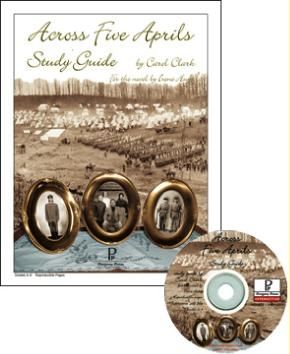
I vaguely remember reading Across Five Aprils when I was in junior high, I believe. I know it was not one I chose for myself, and that I don't remember the books that were assigned to me as well as I remember others that I chose to read. That said, out of the list of books to choose from which have associated Progeny Press Study Guides, I chose Across Five Aprils because while I don't think Wonder Boy is ready to read it yet - skillwise - I think he would be highly interested in the subject matter of the Civil War.
I have not started assigning reading books yet in our lesson plans, however, I plan to start next year. I have wondered how to help my children get the most out of assigned books, and I feel that Progeny Press Study Guides may be a good way to do that. There are guides starting at the early elementary level, including subjects such as The Courage of Sarah Noble and Frog And Toad Together, on up through high school (The Adventures of Huckleberry Finn and Hamlet, amongst others).
From the website:
Progeny Press study guides are designed to help students better understand and enjoy literature by getting them to notice and understand how authors craft their stories and to show them how to think through the themes and ideas introduced in the stories. To properly work through a Progeny Press study guide, students should have easy access to a good dictionary, a thesaurus, a Bible (we use the NIV translation, but that is up to your preference; just be aware of some differences in language), and sometimes a topical Bible or concordance. Supervised access to the Internet can also be helpful at times, as can a good set of encyclopedias.It is suggested that the student read the book first, in its entirety, then go back and work through the study guide. For Across Five Aprils, there were a few activities to do before or while reading the book, but most were done after. It seems to me that the study guide could be used along side the book, as some of the books could take longer than a week (what the site suggests) to read, depending on how much other school work a child has, and their interest level in the book.
I love that in addition to the traditional literature questions, there is a combination of vocabulary, history, and creative writing included in the study guide activities, as well as relating the story to the Bible. There are a variety of methods used to reinforce the target knowledge, which helps keep the material fresh. Another great thing is that the guide is a PDF file, which can be filled in on the computer or printed off for the child to use. My kids love doing any schoolwork they can on the computer, and this method saves us money on ink and paper! I definitely think I will be turning to Progeny Press for other guides in the future!
Progeny Press Study Guides can be found at www.progenypress.com. They are available in a variety of forms, including a paper booklet, cd, and email attachment. Price depends on the guide and form you choose. You can also purchase the books on which the guides are based, if you would like.
***Note: I received a digital copy of a Progeny Press Study Guide in exchange for my review through TOS Homeschool Crew. All opinions are my own.
Friday, March 16, 2012
TOS Review: The Art of Argument
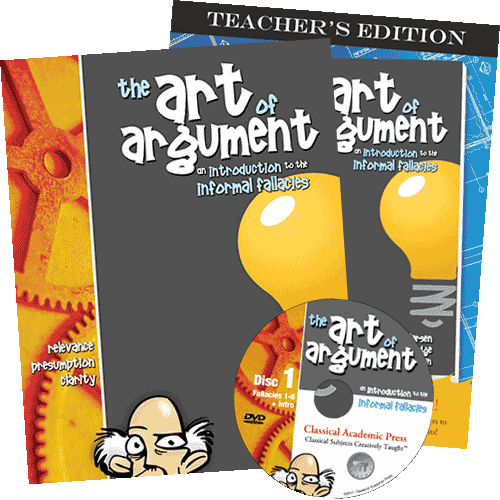
I have mentioned previously that I don't follow the classical method of homeschooling. It just doesn't seem to fit us. That said, I was intrigued when the opportunity arose to review The Art of Argument from Classical Academic Press. Mr. Man loves a good debate and is all about logic, and I found myself wondering if the kids and I could learn to
I have enjoyed reading through the lessons. They are written at a junior high level, and I found that they are a great balance of wit and instruction. The lessons are easy to read, but not "dumbed down". Words are used that a student might not know, but it is not overwhelming, and the student is encouraged to look those words up (which by junior high, a student should be in the practice of doing, anyhow). The idea of fallacies and different meanings of the word argument are introduced in a way that is easy to grasp, even for my mind, which tends to shut down at the thought of such things. This is why I need help teaching it to my children.
There are 28 fallacies, and somewhere around 40 lessons, if you count the introduction lessons, reviews, and tests. Depending on the student, some of the lessons could be completed in the same day. The lessons are comprised of a mix of teaching narrative, "conversations" with Socrates, and hypothetical ads. After reading through the introduction, I am thoroughly convinced of the need for my children to understand this topic, even if they don't remember the names of the fallacies later in life.
I do, however, have a nit to pick with this curriculum. While browsing the tests, I noticed a question about The Salvation Army. The statement was this: "This Christmas, leave behind the packed malls and the tinsel. There are families right in your hometown who are struggling to make ends meet. Please support them by donating to [The] Salvation Army." The student is supposed to identify this as an appeal to pity fallacy. However, the very first paragraph of the chapter on this specific fallacy reads, "When a hunger-relief organization appeals to your pity for support of people in great need of food, is that organization committing a fallacy? No. In fact, it is quite right to be moved with pity for those in need, and appealing to that pity need not be a fallacy." My brain can't make those two things go together. The correct answer to the test is that the statement about The Salvation Army is a fallacy, but it's not a fallacy to appeal to people to help the needy?
That said, it is just one tiny issue with what has so far been a very good curriculum. If you are interested in helping your child learn to make more valid arguments and to be able to identify when the wool is being pulled over their eyes, I encourage you to check out The Art of Argument. It is available from Classical Academic Press in a set for $88.95, which includes a student book, a teacher book, and a DVD set with discussions of the fallacies amongst a group of students and teachers. Each item is also available separately.
***Note: I received a student copy, a teacher copy, and the first DVD of The Art of Argument in exchange for my review through TOS Homeschool Crew. All opinions are my own.
Wednesday, March 14, 2012
TOS Review: Creek Edge Press Task Cards
Creek Edge Press Task Cards are a slightly different approach to homeschooling than my family is used to. What you receive with each set is a teacher/parent guide and a set of cards. The tasks are designed to be largely self-directed, which I thought was not new to us. However, these tasks are meant to be open-ended, meaning there is no set end point to each assignment. The child decides when they are finished, which is new for us. My children are used to lessons - whether they be in book form, video, or on the computer - that have stopping points. This is not a bad thing, being open-ended. It's simply different. If you feel this approach isn't right for your family, I feel that these cards could still be used in a more guided way. The sets are specifically meant for grades K - 8. Most of the tasks are reading-centered, meaning that the lower grades would probably still need a lot of help, anyhow.
The website explains how the Task Cards can be used within several different styles of homeschooling:
The guide suggests how to set up a sort of learning center devoted to the cards and the subject being covered, allowing the child to work through the cards at their own pace, and providing diverse materials for them to learn from. Task Card sets are available in subjects focusing on most areas covered by homeschoolers: Science; History, Geography, and Culture; Art; Music; and Grammar Reinforcement. There are no specific book titles or materials required to complete the tasks, which makes it easy for a family to be flexible with their supplemental materials.
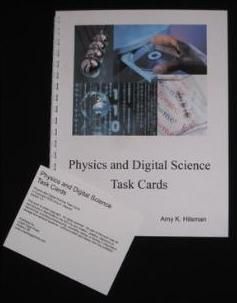
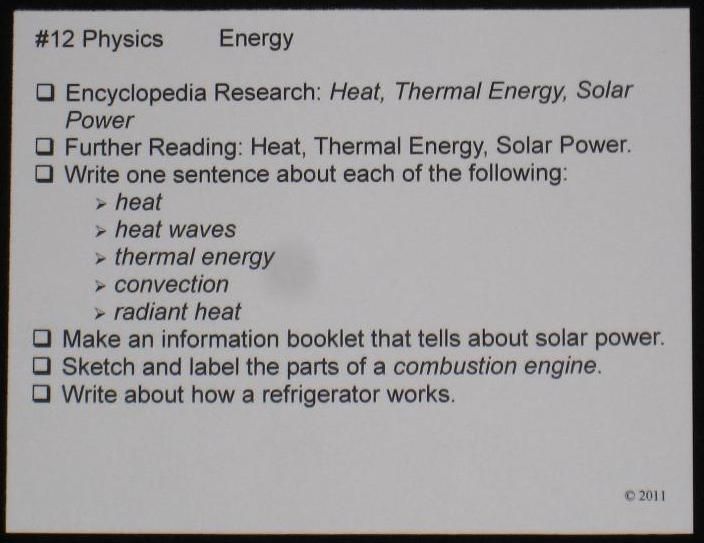
I received the Physics and Digital Science set for my review. After reading through the cards, I saw a pattern emerge: read about a term in an encyclopedia, read about the term some more in some supplemental books, define the term, make a list about the term, take pictures and print them, make a poster or booklet about the term, then display the end result. The cards are not all exactly the same, but this pattern is definitely recurring. The guide describes these as "hands-on" activities, and while the parent is encouraged to put science kits in the center, the activities on the cards are definitely more reading and writing centric.
I like the idea of the Task Cards. However, I'm not so certain about the Montessori style of learning. Since this area of science is not our focus this year, I feel like it's a good way to try the cards and the style out by having my children complete a card per week. The other thing I would say about these cards is that the sets are produced by a homeschooling mother, not a large company. The cards are printed on card stock, but meant to be non-consumable. I would highly suggest laminating the cards before handing them over to your kids. That would allow students to mark off each task (using a wipe-off marker) as they complete it, and still protect the cards from wear and tear.
Creek Edge Press's Task Cards can be found on their website, www.creekedgepress.com. Sets begin at $18, and replacement cards are also available. Right now, using the code "MidWinter", you can score free shipping on orders of $36 or more!
***Note: I received a set of Task Cards in exchange for my review through TOS Homeschool Crew. All opinions are my own.
The website explains how the Task Cards can be used within several different styles of homeschooling:
Classical – The tasks point to key vocabulary that students will use in future years of study. The tasks encourage students to read, think, and respond. The research tasks facilitate a habit of reading for detail, preparing the grammar stage student for work in the dialectic stage.
Charlotte Mason – The tasks rely on narration, in a variety of forms, as a primary means of response to reading and listening. The student encounters meaningful ideas and beautiful expression within the materials chosen for study.Montessori – The parent prepares a learning environment and the student engages in research tasks indicated on the cards. While the topics on the cards are specific, the tasks are purposely open ended to allow for individual investigation and response at the student's pace.
The guide suggests how to set up a sort of learning center devoted to the cards and the subject being covered, allowing the child to work through the cards at their own pace, and providing diverse materials for them to learn from. Task Card sets are available in subjects focusing on most areas covered by homeschoolers: Science; History, Geography, and Culture; Art; Music; and Grammar Reinforcement. There are no specific book titles or materials required to complete the tasks, which makes it easy for a family to be flexible with their supplemental materials.
I received the Physics and Digital Science set for my review. After reading through the cards, I saw a pattern emerge: read about a term in an encyclopedia, read about the term some more in some supplemental books, define the term, make a list about the term, take pictures and print them, make a poster or booklet about the term, then display the end result. The cards are not all exactly the same, but this pattern is definitely recurring. The guide describes these as "hands-on" activities, and while the parent is encouraged to put science kits in the center, the activities on the cards are definitely more reading and writing centric.
I like the idea of the Task Cards. However, I'm not so certain about the Montessori style of learning. Since this area of science is not our focus this year, I feel like it's a good way to try the cards and the style out by having my children complete a card per week. The other thing I would say about these cards is that the sets are produced by a homeschooling mother, not a large company. The cards are printed on card stock, but meant to be non-consumable. I would highly suggest laminating the cards before handing them over to your kids. That would allow students to mark off each task (using a wipe-off marker) as they complete it, and still protect the cards from wear and tear.
Creek Edge Press's Task Cards can be found on their website, www.creekedgepress.com. Sets begin at $18, and replacement cards are also available. Right now, using the code "MidWinter", you can score free shipping on orders of $36 or more!
***Note: I received a set of Task Cards in exchange for my review through TOS Homeschool Crew. All opinions are my own.
Friday, March 2, 2012
TOS Review: Reading Eggs
Have you heard of Reading Eggs? It's an educational website where children can learn to read or improve their reading skills in a an animated world. Reading Eggs has the familiar set-up of many websites, where the user selects an avatar, has a house to decorate, can buy virtual items in a shop, and travel around in the make-believe world. What's different from a regular gaming site is the 100 lessons aimed at helping children "become great readers!". The website specifically says it is geared toward 4-7 year old beginning readers, and 6-8 year olds who read but need some practice. I think the site could easily be used with slightly older children who still need help, and slightly younger children that are ready to start reading would definitely like it, as long as they have the computer skills necessary. In fact, there is a "playroom" for preschoolers, as well as the "Reading Eggspress" for older children to continue practicing their skills.
As your child works through the lessons, they earn "golden eggs", which can be redeemed to play games. They also get a new virtual book and animal to add to their collection. The books contain only words the child has learned so far, and help reinforce the lessons. Print versions are also available, so that your child can practice their new skills anywhere!
Reading Eggs is web-based, and available as a monthly subscription for $9.95, six months for $49.95, or 12 months for $75. The second and third child registered at the same time are half price.
***Note: I was given a one year subscription to Reading Eggs in exchange for my review through TOS Homeschool Crew. All opinions are my own.
Subscribe to:
Posts (Atom)